Cisco ThousandEyes is now integrated with Cisco Cloud Control, bringing end-to-end assurance intelligence into a unified, AI-driven operational experience across Cisco. NetOps teams can access ThousandEyes workflows, inventory, and actionable alerts alongside intelligence from across their Cisco environment and use the unified AI Assistant and AI Canvas to help investigate performance, correlate cross-domain evidence, and isolate issues faster.
Modern network operations rarely stay within the boundaries of the network.
A user reports that an application is slow. The campus network looks healthy. The WAN is up. But the application depends on an Internet service provider, cloud infrastructure, DNS, SaaS services, and other external dependencies that the enterprise does not own or directly control.
For NetOps, the technical challenge is often not a lack of telemetry. It is assembling the right telemetry quickly enough to answer three basic questions:
Is there actually a problem? Where is it occurring? And what should I investigate next?
Answering those questions can require operators to move between network controllers, monitoring platforms, cloud consoles, dashboards, and more, forcing them to rebuild context at every step. With ThousandEyes integrated into Cisco Cloud Control, we are changing that operating model.
ThousandEyes assurance intelligence can now become part of the broader Cisco operational context, helping teams connect what is happening across the enterprise network with what’s happening across cloud, SaaS, and the Internet. The result is a more connected path from signal to investigation to root cause.
From Multiple Operational Views to Connected Context
Cisco Cloud Control brings inventory, actions, identity, AI, and workflows together within a unified operational experience.
ThousandEyes adds an important dimension to that model, visibility beyond the traditional boundaries of the enterprise network. ThousandEyes vantage points and telemetry help operators understand the complete service-delivery path across enterprise infrastructure, ISPs, cloud providers, SaaS applications, and other critical external dependencies. By bringing that intelligence directly into Cisco Cloud Control means it can be placed in context alongside information from other Cisco products.
That matters when the source of an issue is unclear. Take for example, a branch application problem. In this case it may originate with the local network, WAN, an ISP, cloud infrastructure, or the application provider itself. Looking at each domain independently forces an operator to manually establish relationships between symptoms.
The Cloud Control experience is designed to make those relationships easier to investigate.
For ThousandEyes customers, the integration includes:
Integrated navigation that makes ThousandEyes accessible through the Cisco Cloud Control experience while retaining the complete ThousandEyes navigation and workflows.
Context-aware access that is designed to protect user identity, permissions, organization, and account-group access between Cisco Cloud Control and ThousandEyes.
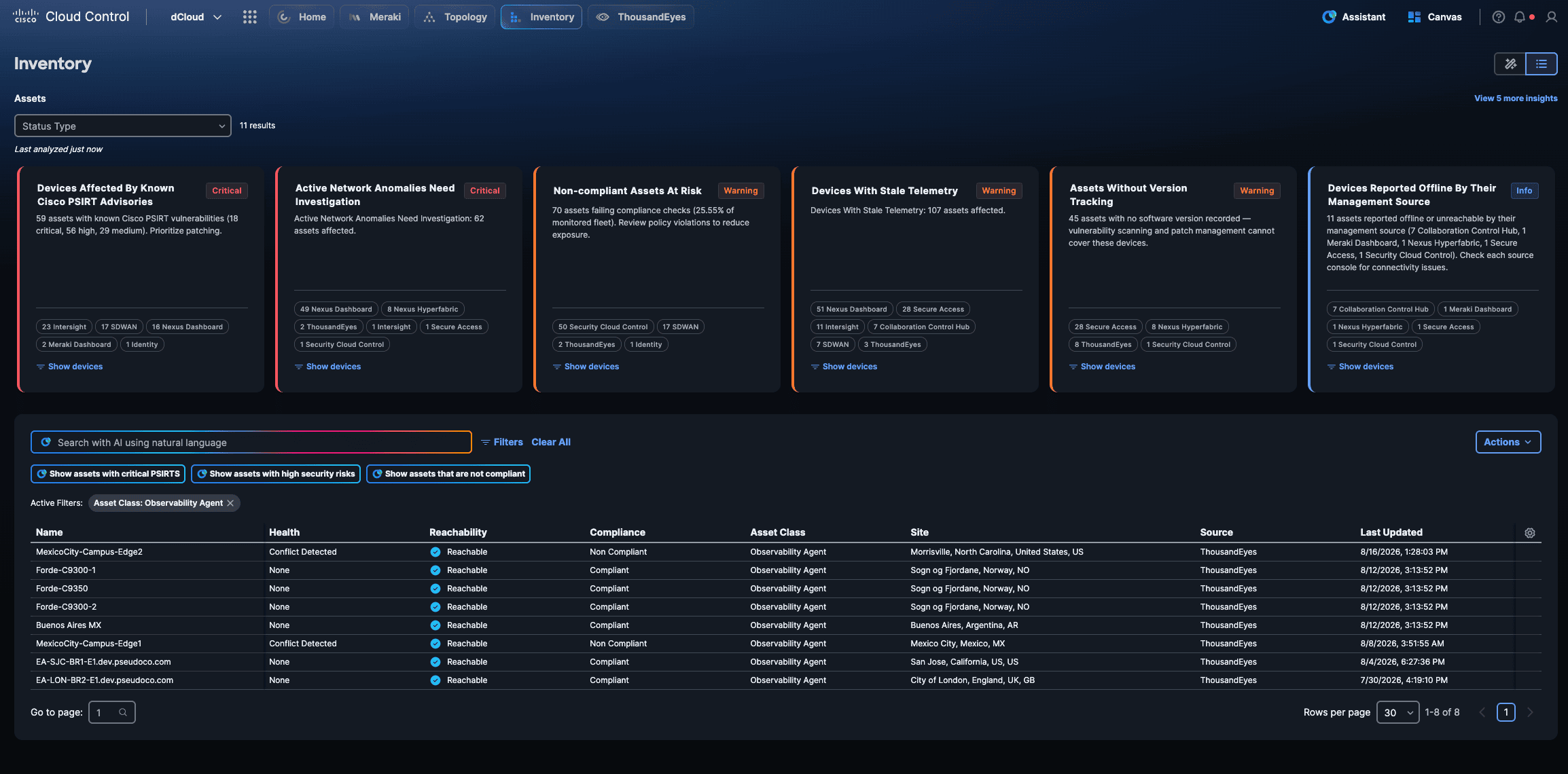
Enterprise Agent visibility in Inventory, providing supported identity and operational metadata for ThousandEyes Enterprise Agents alongside assets from connected Cisco products.
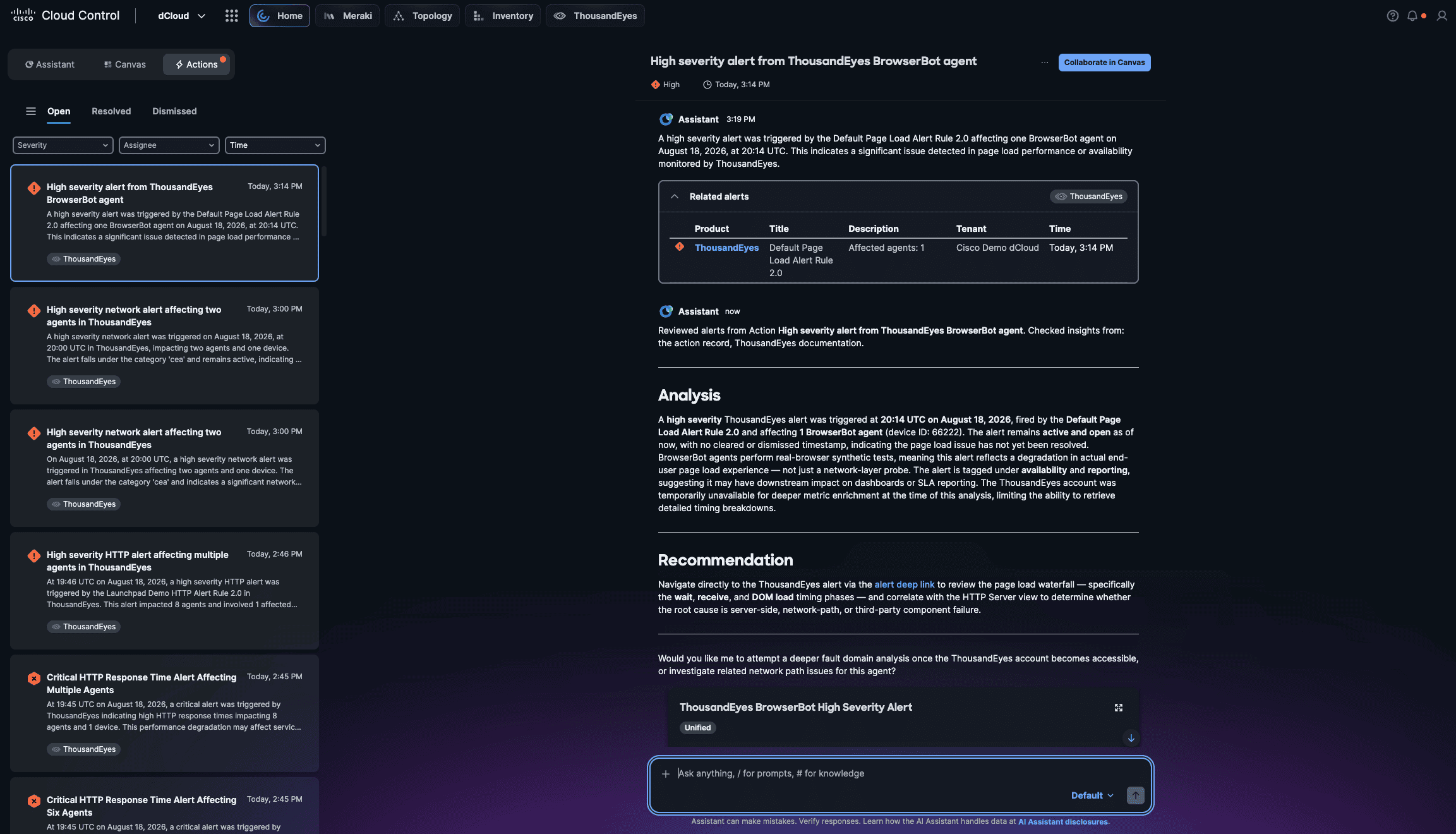
ThousandEyes alert information in Notifications, helping operators identify assurance signals requiring attention.
AI-powered workflows through AI Assistant and AI Canvas, bringing supported ThousandEyes intelligence into AI-assisted investigations.
This isn’t about creating another dashboard. It is about reducing the operational distance between detecting a problem and understanding it.
Bring Assurance Signals Into the Operational Workflow
When an issue emerges, NetOps needs to quickly determine what is actually worth investigating. ThousandEyes continuously measures network and application experience to detect conditions such as availability, latency, and packet-loss degradation. Through Cisco Cloud Control, supported Enterprise Agent alerts are surfaced in Actions, putting ThousandEyes assurance signals alongside another operational context. This helps teams identify potentially user-impacting issues earlier, prioritize where to investigate, and move directly into deeper ThousandEyes analysis when needed. An alert might indicate elevated latency or packet loss associated with an Enterprise Agent monitoring a critical application. From there, the operator can move into the appropriate ThousandEyes workflow or continue the investigation through Cisco’s AI experiences. This is where the integration becomes more than navigation. The signal becomes context for the next step.
Ask the Network What’s Happening
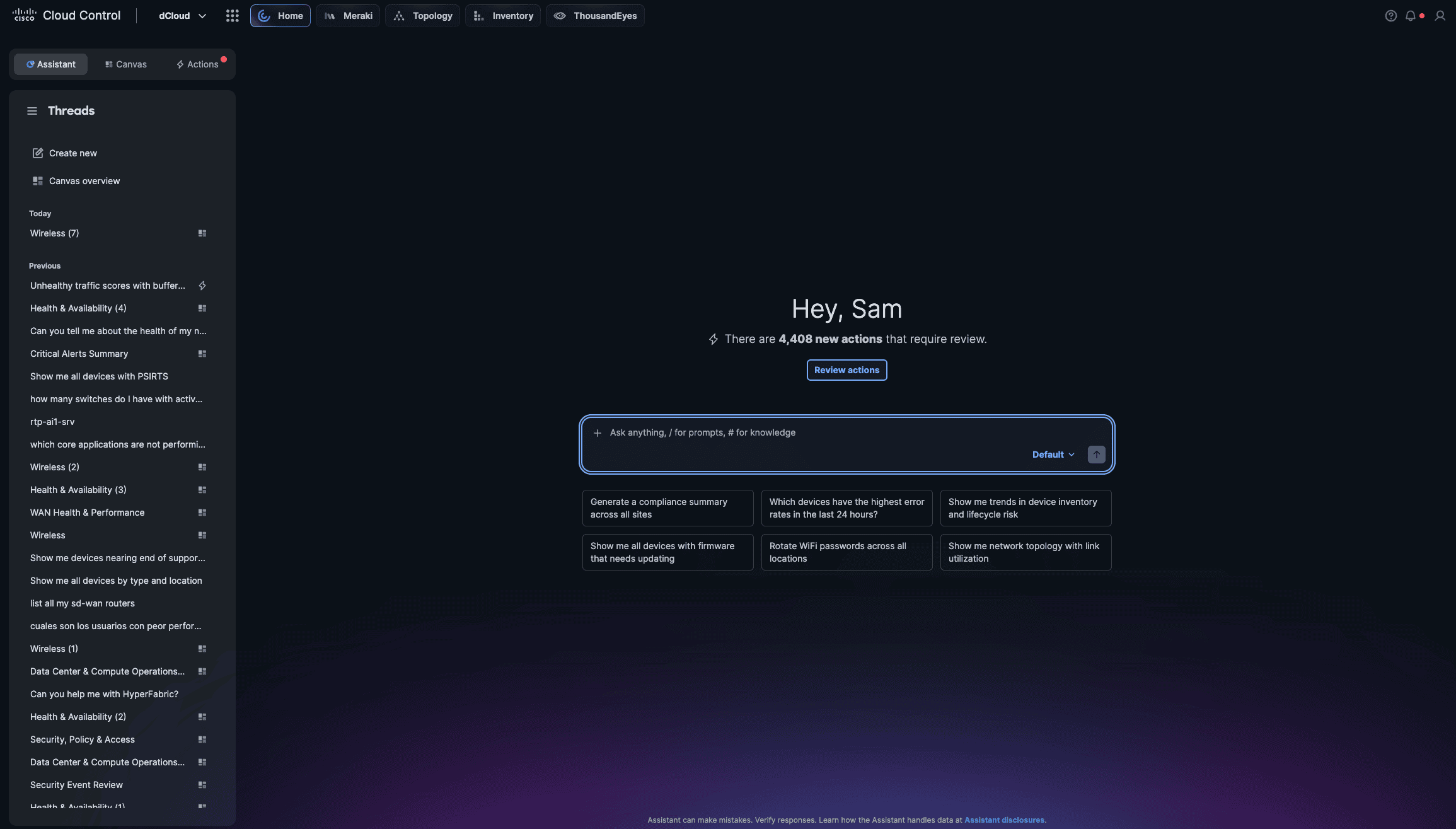
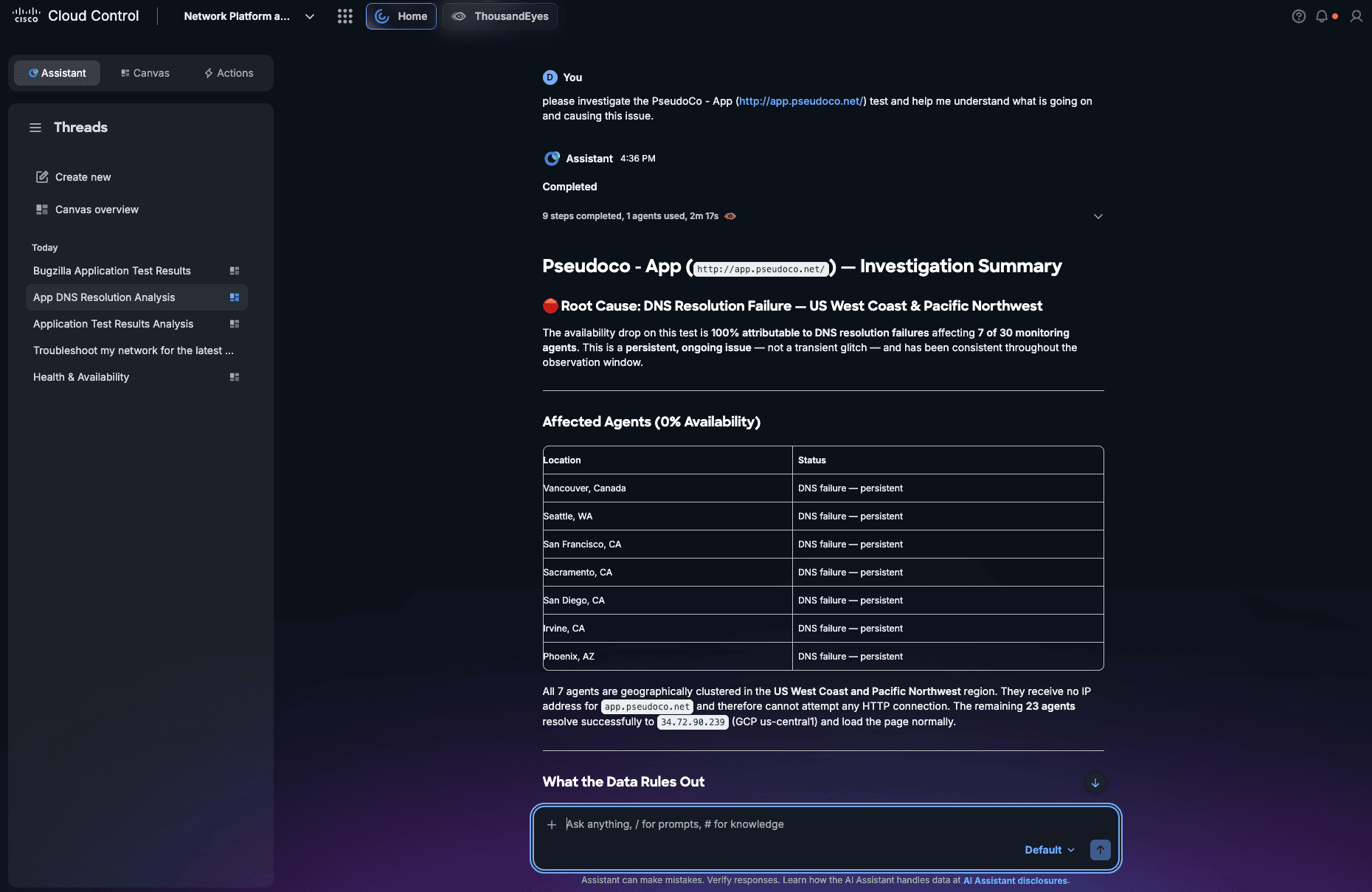
The next evolution is changing how operators interact with this data. Cisco Cloud Control’s AI Assistant provides a natural-language entry point into operations. Rather than beginning every investigation by deciding which dashboard, view, or query to open, an engineer can begin with the question they are trying to answer.
For example: “Why are users at the Seattle office experiencing poor application performance?”
That question alone contains operational intent, not a request for a particular metric. AI-assisted workflows can use available context and supported ThousandEyes capabilities to help investigate the issue. ThousandEyes intelligence can contribute evidence such as network performance metrics, alerts, and path information that helps determine whether degradation is occurring within the enterprise environment or somewhere beyond it.
That distinction is critical. Traditional network telemetry may show that the network equipment is functioning correctly. ThousandEyes can extend the investigation into the end-to-end delivery path, helping expose latency, packet loss, routing changes, or service degradation occurring across infrastructure outside the enterprise’s direct control.
Instead of asking an operator to know where to look first, AI can help operators determine what evidence matters next.
Go Deeper With ThousandEyes Intelligence in AI Canvas
Some operational questions can be answered quickly. Others require investigation. That is where AI Canvas becomes especially powerful.
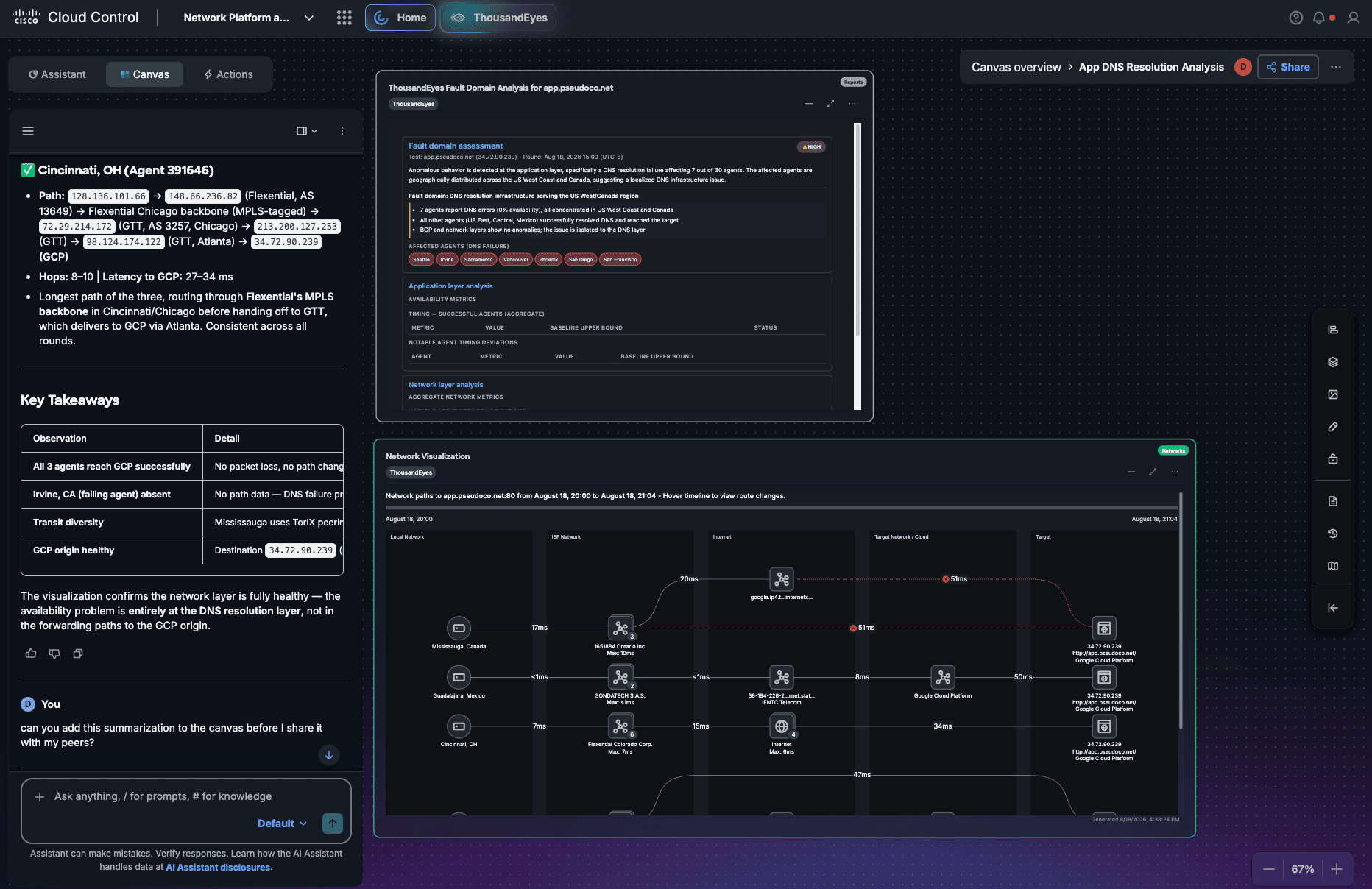
AI Canvas provides a collaborative workspace where operators and AI agents can investigate complex issues using information from across supported Cisco products. Rather than treating each data source as an isolated dashboard, Canvas can bring relevant evidence into the investigation as it unfolds. ThousandEyes adds end-to-end telemetry across the service-delivery path, helping broaden the evidence available during an investigation. Depending on the supported workflow and available telemetry, ThousandEyes intelligence can help surface:
Network latency, packet loss, jitter, and availability
Application and network test results
ThousandEyes alerts and events
Network path and hop-level information
Fault-domain information that helps distinguish between enterprise, WAN, Internet, cloud, and application dependencies.
This is particularly useful for problems where everything inside the network initially appears healthy.
Consider a branch where employees report intermittent problems accessing a SaaS application. In this case the local infrastructure may be operational. WAN connectivity may appear normal. But a ThousandEyes network path could reveal elevated packet loss several hops upstream through an external provider. Instead of forcing the operator to manually compare multiple views, AI Canvas can bring relevant evidence together within the investigation shared workspace.
A NetOps Workflow: From User Complaint to Fault Domain
Consider a common scenario. Employees at a branch report that a business-critical SaaS application has become slow.
Historically, the investigation might begin with the local network. An engineer checks clients, switches, wireless health, WAN connectivity, application availability, and then moves into ThousandEyes to look at the Internet and application performance. Each step may produce useful information, but the engineer is responsible for correlating it.
With ThousandEyes and Cisco Cloud Control, the workflow becomes more connected.
Start with the operational signal: A user complaint or action provides the starting point for the investigation.
Establish infrastructure context: Cisco networking intelligence helps determine whether the relevant infrastructure, clients, or site are experiencing known problems.
Bring in ThousandEyes assurance intelligence: ThousandEyes telemetry helps determine whether application or network performance degradation is occurring along the service-delivery path.
Examine the network path: Path intelligence can help identify where latency or packet loss begins and whether the affected segment belongs to the enterprise, an ISP, cloud provider, or another external dependency.
Correlate the evidence: AI Assistant or AI Canvas can help operators work across supported data sources and maintain the context of the investigation.
In this case the operational question changes from, “Which tool should I check next?” to, “What does the evidence tell me about where this problem is occurring?”. That is a much more useful question for NetOps.
Context That Follows the Investigation
There is another important aspect of the integration that may be less visible but matters significantly in day-to-day operations and that is context handoff.
Cisco Cloud Control and ThousandEyes maintain user identity, organization, permissions, and account-group access as users move between supported experiences. That means an engineer can begin with broader operational context in Cloud Control and move into ThousandEyes when deeper investigation is required without treating the two environments as disconnected workflows. And ThousandEyes remains ThousandEyes.
Operators still have access to the complete ThousandEyes navigation and its specialized workflows when they need to move from cross-domain triage into detailed assurance analysis. In this case Cloud Control doesn’t eliminate the specialized tools NetOps teams depend on. It connects them.
Built for the Way Network Operations Is Changing
This integration is important for another reason. Network operations is moving from dashboard-driven workflows toward AI-assisted and increasingly agentic operations.
AI can investigate faster than a human operator can manually navigate a collection of tools. However, the quality of an AI-driven investigation depends on the quality and completeness of the operational data and context available to it.
A network device telling an AI system that it is healthy is useful but it’s not enough. Digital experience depends on the entire service-delivery chain, from the user and enterprise network through the WAN, Internet, cloud, SaaS provider, and application.
ThousandEyes provides intelligence across that chain, including domains enterprises rely on but don’t own or control. By making that intelligence available within Cisco Cloud Control and its AI experiences, we are giving operators, and the AI systems assisting them, a more complete foundation to determine what exactly is happening.
Doing so creates a path toward operations where AI can help teams:
Detect what matters.
Gather the relevant evidence.
Correlate signals across domains.
Identify the likely fault domain.
Recommend the next step.
And ultimately help validate the outcome.
For NetOps, the value is not AI for AI’s sake. It is spending less time gathering context and more time resolving the problems affecting users.
Getting Started
The Cisco ThousandEyes integration with Cisco Cloud Control is available for eligible ThousandEyes organizations hosted in the US1 and US2 regions that use Cisco Unified Identity (CUI). Managed service provider organizations are not currently supported.
Once connected, eligible organizations can access supported ThousandEyes capabilities through Cisco Cloud Control, including integrated navigation, Enterprise Agent information in Inventory, Enterprise Agent alerts through Actions, and supported ThousandEyes experiences through AI Assistant and AI Canvas.
Inventory and alert information currently use batch updates, so changes may take up to approximately one hour to appear in Cisco Cloud Control.
See More. Understand Faster. Operate With Assurance.
Networks no longer end at the edge of the enterprise, and network operations cannot end there either.
Applications depend on infrastructure spanning enterprise networks, Internet providers, cloud platforms, SaaS services, and increasingly complex external dependencies. NetOps teams need to understand all those domains without rebuilding operational context every time they cross a technology boundary.
Bringing Cisco ThousandEyes into Cisco Cloud Control is an important step toward that future. It puts end-to-end assurance intelligence closer to where operators already investigate and act. It brings ThousandEyes data into context alongside intelligence from across Cisco. And through AI Assistant and AI Canvas, it creates new ways for teams to investigate complex performance problems using natural language, cross-domain evidence, and collaborative AI-driven workflows. Because the goal isn’t simply to collect more network data. It’s to give NetOps the context to understand what is happening, isolate where it is happening, and act with assurance.
Learn More
Explore Cisco Cloud Control and Cisco ThousandEyes to learn how Cisco is bringing networking, assurance, and AI together for the next generation of network operations.